
Indigenous Peoples Day 2026
Revisiting the High Watermark of Right Relation with the Native Nations: A Celebration of National Indigenous Peoples’ Day
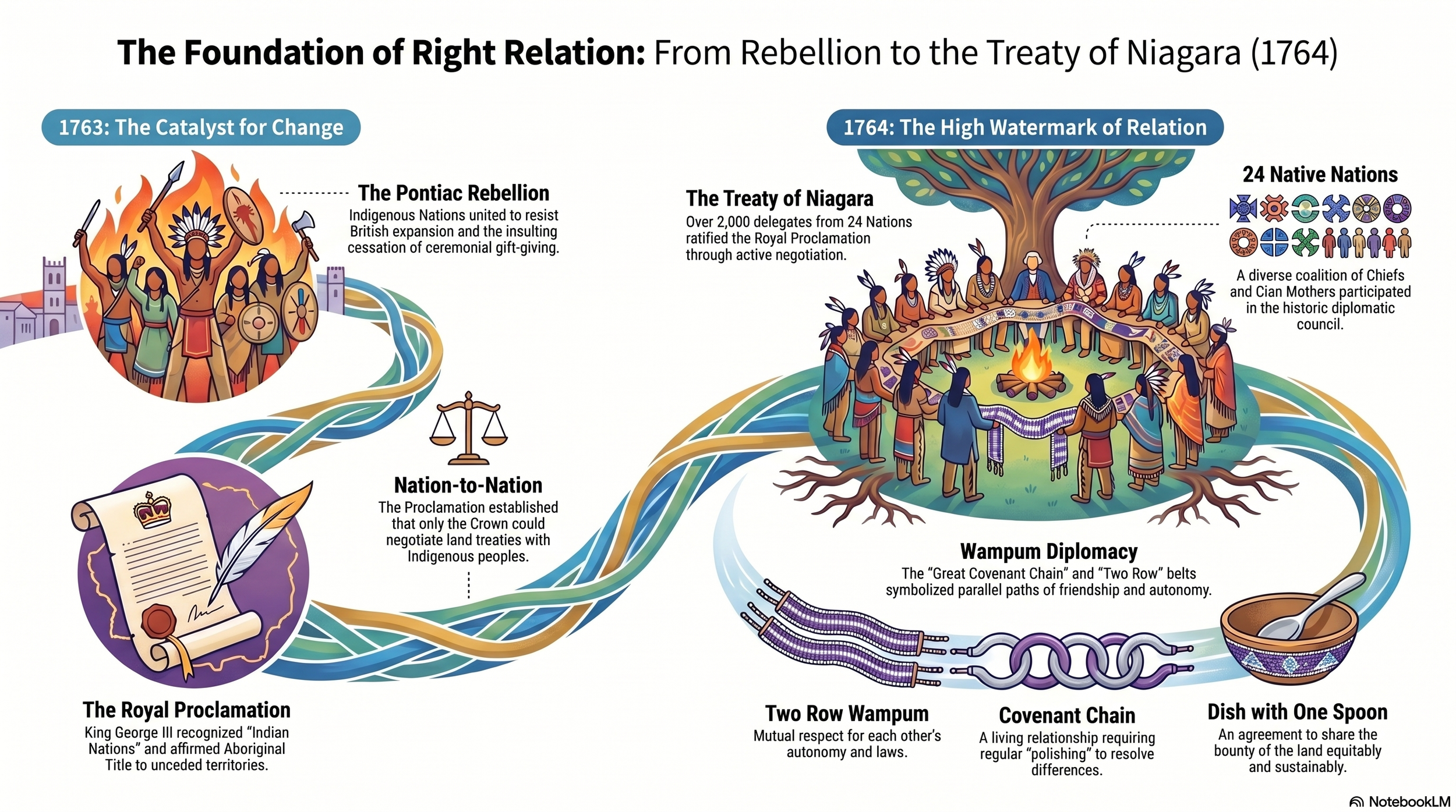
Steve Watson, a long-time member of West Hill, takes the mic this Sunday - National Indigenous Peoples' Day (CA) - to tell the story of how the Treaty of Niagara of 1764 was negotiated between the Crown and 24 Indigenous Nations here on Turtle Island.
In presenting this Treaty as the “high water mark” of right relation with between Canada and Indigenous peoples, Steve will illustrate how the treaty came together as a creative fusion of Indigenous and British legal traditions; it was not a one-way, top-down imposition of an edict on native peoples, but instead, the result of two societies finding a path to peace and friendship to the mutual benefit of all parties.
Steve draws on his experience as a union educator and an active ally of Native people to highlight the Truth and Reconciliation Commission’s Report: Call to Action #45, which calls on the Government of Canada to jointly develop with Aboriginal People a “Royal Proclamation of Reconciliation”, building on the principles of the Royal Proclamation of 1763 and the Treaty of Niagara of 1764.
The historical contribution of a long-overlooked Mohawk Clan Mother, Molly Brant - Konwatsi-‘tsiaienni, will be honoured, while we join in community to discuss and share ideas on what a proclamation of reconciliation might include.
We hope you'll join Steve and West Hill’s global family, for this meaningful gathering.
Watch the gathering here
READINGS
I Lost My Talk
Rita Joe (1932 -2007) Mi'kmaq poet and residential school survivor
I lost my talk
The talk you took.
A way to remember
The things you forgot.
The scraped stone,
Face in the wind
The lost Indian
I think I was.
The word you gave me
To use instead
Of what I was created to use.
Let me find my talk,
So I can teach you
About me,
As I am.
Daniel Heath Justice in his book “Why Indigenous Literatures Matter”
“According to the settler stories of Indigenous deficiency, our people were supposed to vanish into the sunset long ago.
In spite of all their hopes and ambitions, policies and practices, laws and customs, and assaults and editorials, our people are still here, as are our relations, as are our stories. In fact, our stories have been integral to that survival…They are good medicine. They remind us about who we are and where we’re going, on our own and in relation to those with whom we share this world. They remind us about the relationships that make a good life possible. In short, they matter.”