
ALONE ON THE HIGH SEAS
A reflection on learning to live with loss of things and people who gave our lives meaning. Who am I when no one else is around? Who am I when it all falls away?
MEET ALISON BROOKS-STARKS
Alison is a ministry school drop-out, an outdoor educator and a modern-day Thoreau.
His longest stretch of intentional solitude was a 28-day paddle, solo, along the North Saskatchewan River from Edmonton, Alberta to Prince Albert, Saskatchewan.
Ask him about the geese. He can be reached at his landline. ;)
Watch the gathering here
READING
The Middle Passage: From Misery to Meaning in Midlife by James Hollis (published in 1993)
Excerpt from Chapter 6 - On the High Seas and Alone
From Loneliness to Solitude
The American poet Marianne Moore once wrote that "the best cure for loneliness is solitude." What does she mean? What is the difference between loneliness and solitude?
Loneliness is not a contemporary discovery, nor is the flight from it. The seventeenth-century philosopher Blaise Pascal observed in his Pensées that the jester was invented to divert the king from loneliness for, king though he may be, if he think of self he would grow vexed and anxious. So, Pascal argued, all of modern culture was a vast divertissement to keep us from loneliness and from thinking of self. Similarly, Nietzsche wrote a hundred years ago, "When we are alone and quiet we are afraid that something will be whispered in our ear, and so we hate the silence and drug ourselves with social life."
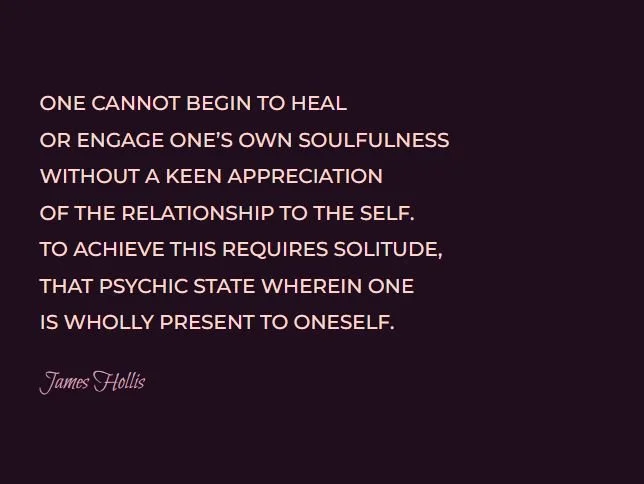
One cannot begin to heal or engage one's own soulfulness without a keen appreciation of the relationship to the Self. To achieve this requires solitude, that psychic state wherein one is wholly present to oneself. Following are some of the issues which must be confronted if one is to move from loneliness to solitude.
Absorbing the Trauma of Separation
It is difficult to fully appreciate either the trauma of birth, which is a primal separation, or the full effects of the parent-child relationship. The more beneficent that relationship, the more one will be self-sufficient and comfortable with solitude. Paradoxically, the more troubled the relationship to the parent, the more dependent the person will be on relationships in general. The more volatile the parental environment, the more one learns self-definition only in terms of the Other.
Jung put parents in a difficult spot when he wrote that they "should always be conscious of the fact that they themselves are the principal cause of neurosis in their children." This is cited here not to instill guilt in parents, but to remind us of just how much we have been defined by them and by parent substitutes such as social institutions.
To move to the necessary solitude in which individuation can proceed, one must consciously ask each day, "In what way am I so afraid that I am avoiding myself, my own journey?" The codependent adult has learned to avoid his or her own being. The cliché "to get in touch with one's feelings" really asks us to define ourselves from an inner reality rather than an outer context.
We must further ask of our responses to others, "Where is the parent lurking here?" Then we may operate out of personal integrity. The more traumatic the childhood, the more infantile our sense of reality. It is very hard to know our reality and to operate from its baseline. Risking loneliness to achieve that sense of oneness with oneself we call solitude is essential if one is to survive the Middle Passage.
Loss and the Withdrawal of Projections
Great losses often occur at midlife: children move away, a friend dies, divorce devastates. The loss of that necessary Other can be as existentially terrifying as the loss of the parent would be to the child. The loss creates not only angst but a loss of identity. (A popular song laments, "Can't live if living is without you...")
What this tells us is how much of our lives have been caught up in the projections of meaning and identity onto the Other, be it spouse, child, or persona. Yes, some people feel liberated by a divorce or the departure of a child, but many do not.
What is essential is to honor the relationship by feeling its loss, and yet recognize that one has had, all along, a commitment larger than any single relationship.
A person who has suffered loss and the withdrawal of projections will have struggled with the dependencies which haunt us all, but also will have asked the next question, "How much of the unknown me was tied up in that person or that role?" When we can acknowledge loss and recoup the energy that was once invested outside ourselves, it becomes available for the next stage of the journey.
Ritualizing Fear
People so fear loneliness that they will cling to terrible relationships and constricting professions rather than risk the consequences of letting go of the Other.
In the end, there is no substitute for the courage necessary to confront loneliness. The something Nietzsche suggested we feared hearing may be useful and liberating. But we will never hear that inner voice unless we risk solitude.
For some, it helps to devise a daily ritual of private meaning which obliges one to sit quietly, with no phone, no children, nothing, and listen to the silence. Such a ritual may at first seem strained and artificial, but sticking to it will allow the silence to speak. When we are not lonely in being alone, then we have achieved solitude. Fear keeps us from this essential meeting with ourselves.
The purpose of a ritual is to link a person to the larger rhythms of life. As they are passed from generation to generation, rituals become routine and lose their original power. All the more reason, then, for the individual to generate a ritual of personal significance, investing it with the same energy previously given to dependencies.
The goal is to still the traffic of the mind, the neurotic clutter which floods and distracts. If we are afraid of being alone, afraid of silence, then we can never really be present to ourselves. Self-alienation is very much the condition of the modern world and it can only be changed by individual action.
So, some part of every day, it is good to risk radical presence to oneself, to follow a quiet ritual of disengagement from the traffic out there and the traffic in here. When the silence speaks, one has gained companionship with oneself, moved from loneliness to solitude, a necessary prerequisite to individuation.