
Discernment as an act of courage
Discernment is an act of courage
How do we make choices that are true to who we are and to what we value most deeply? Discernment invites us to slow down, pay attention, listen deeply, and notice where our lives are calling us. It is not simply about making the “right” decision, but about becoming more attentive to what matters—and allowing that awareness to shape how we live.
Jude Chaytors brings a message this Sunday, exploring how the practice of discernment can support lives of greater integrity, helping us bring our values and our actions into closer alignment. Together, we’ll consider how discernment can move us beyond reflection into courageous living: making choices, taking risks, and responding to the world in ways that are grounded in what we most deeply believe.
Watch the gathering here
FIRST READING - Kahlil Gibran, On Self-Knowledge, from “The Prophet”
And a man said, Speak to us of Self-Knowledge.
And he answered, saying:
Your hearts know in silence the secrets of the days and the nights.
But your ears thirst for the sound of your heart’s knowledge.
You would know in words that which you have always known in thought.
You would touch with your fingers the naked body of your dreams.
And it is well you should.
The hidden well-spring of your soul must needs rise and run murmuring to the sea;
And the treasure of your infinite depths would be revealed to your eyes.
But let there be no scales to weigh your unknown treasure;
And seek not the depths of your knowledge with staff or sounding line.
For self is a sea boundless and measureless.
Say not, “I have found the truth,” but rather, “I have found a truth.”
Say not, "I have found the path of the soul.” Say rather, “I have met the soul walking upon my path.”
For the soul walks upon all paths.
The soul walks not upon a line, neither does it grow like a reed.
The soul unfolds itself, like a lotus of countless petals.
SECOND - The Big Leap by Gay Hendricks
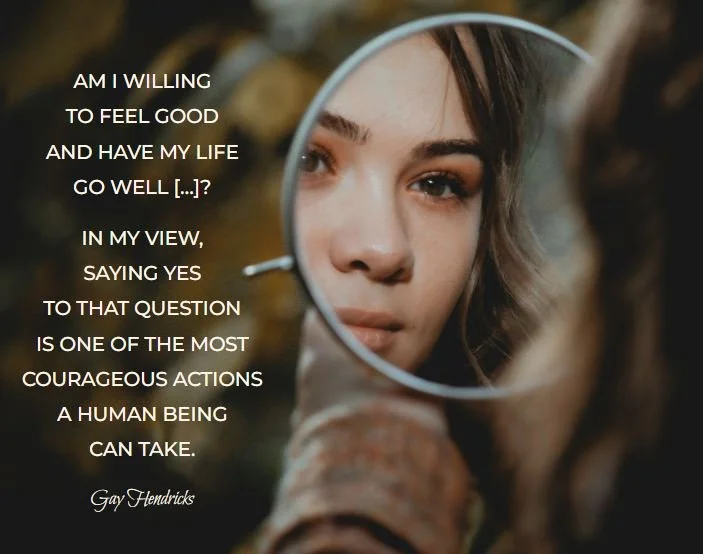
Am I willing to feel good and have my life go well […]?
In my view, saying yes to that question is one of the most courageous actions a human being can take. In the face of so much evidence that life hurts and is fraught with adversity on all fronts, having a willingness to feel good and have life go well […] is a genuinely radical act. Going into space is no longer radical; you can buy a ticket online. However, going into your inner depths, where your most deeply held beliefs about what’s possible reside, counts in my book as a radical act.
THIRD - James Hollis,
"On this Journey We Call Our Life: Living the Questions"
Spiritual integrity means that we learn to be honest with ourselves. […]
To know what is true for us, to feel what we really feel, to believe what makes sense of our unique journey – this is the essence of living a life of spiritual integrity. Not easy, not common.[…]
The principle of resonance (re-sounding) suggests that if something is right for us, consistent with our soul’s need, it will set off an inner tuning fork. The hum of resonance means that some image, belief, or practice is right for us because something within us responds. Like responds to like. Clearly, ego cannot cause this to happen; resonance is autonomous, an expression of the Self. We may try to will something to be true, but it will never be true to us unless it is true for us.
[…]
The principle of resonance is thus the private means by which a person may know what works. And no one else has the right to predetermine that person’s experience. […]
[This] may only be answered in individual ways. My experience is my experience, not yours.
What is yours?
Our souls long for transcendence, for meaning. This is who we most deeply are. When that need is intimidated by fear, diverted by cultural idols, or projected onto others, something terrible happens to our souls. When we learn to face our fear, open to the universe without defense and follow what beckons, we will find our true spiritual path. […]
Jung reminds us that “it is not a question of belief but of experience.” Are we large enough to honor and act upon the reality of our experience? As Jung so eloquently adds: “No one can know what the ultimate things are. We must therefore take them as we experience them. […] such experience helps to make life healthier, more beautiful, more complete and more satisfactory to yourself and to those you love…”